
Glass Cleaning for Dubai High-Rises: Why Standard Methods Don’t Work
Dubai has some of the most glass-heavy architecture in the world. From the curtain-walled towers of DIFC to the residential blocks of JLT and the hotel facades in Marina, the city’s skyline is mostly glass. Keeping it clean is not a job for standard equipment. And the consequences of getting it wrong go beyond streaks.
Here’s how high-rise glass cleaning actually works in Dubai, and why the approach matters more than most building managers realise.
Why Domestic and Standard Commercial Equipment Can’t Do This Work
A standard window cleaning setup works well up to about the third or fourth floor. Extension poles with squeegees can reach to around 8 metres from ground level. Above that, you need a different approach entirely.
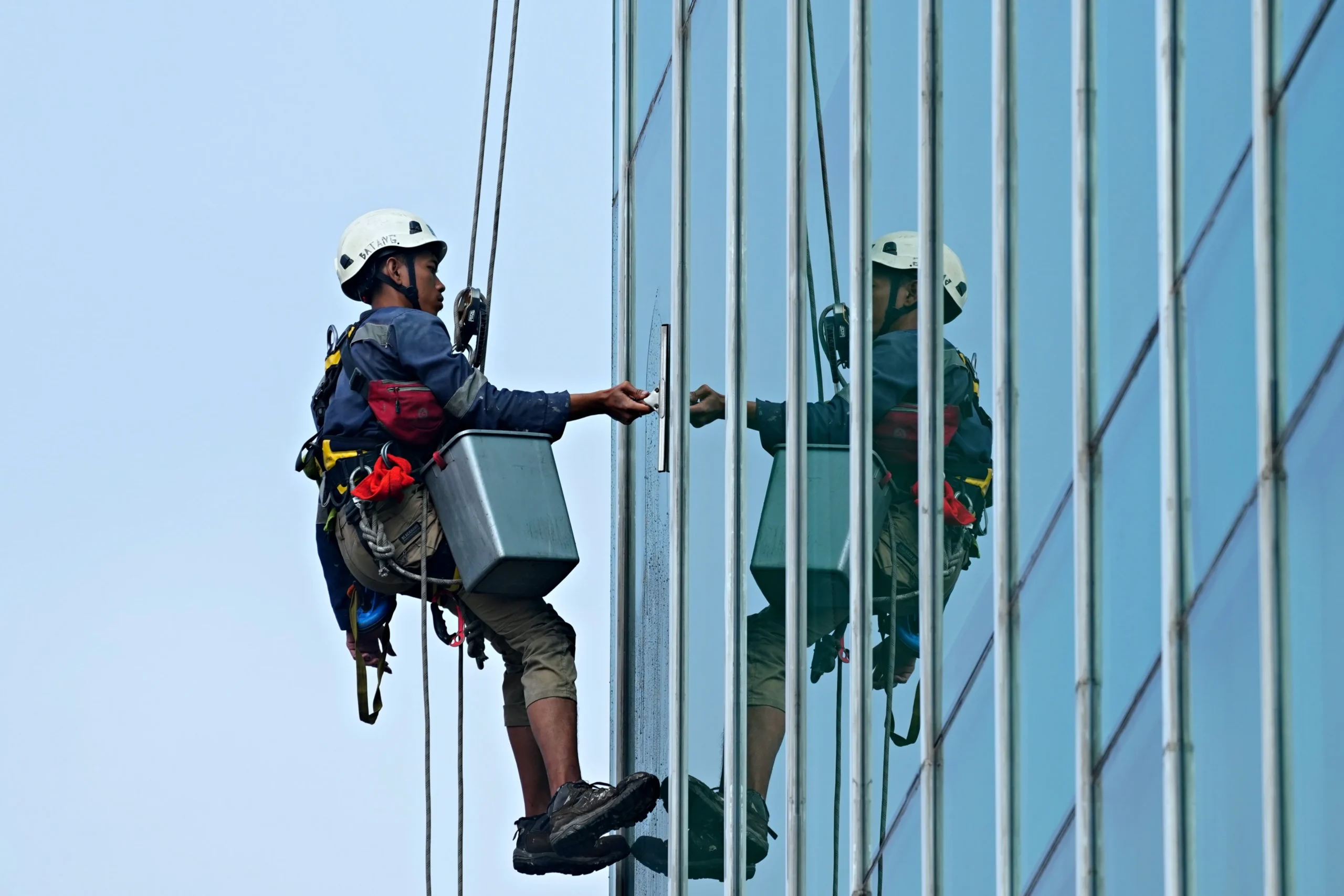
The problem isn’t just reach. At height, you can’t control pressure, angle, or water flow the same way you can from a ladder on the ground. And the consequences of dropped equipment, lost footing, or a pressure washer used at the wrong setting on coated glass are serious. At ground level, a mistake means a re-clean. At 30 floors, it means a safety incident or glass damage that costs tens of thousands of dirhams to repair.
Many building managers in Bur Dubai and Deira with older mid-rise buildings have tried to save money by using window cleaners who work without proper access systems. Aside from the safety risk, the results are usually poor. Streaks from unrinsed detergent, missed sections on the upper panels, and cleaning schedules that can’t be maintained consistently.
The Hard Water Problem in Dubai
Dubai’s water supply is desalinated, and the mineral content after desalination and distribution varies. Water that sits on glass in the Dubai sun evaporates quickly and leaves calcium and magnesium deposits behind. These appear as white or grey spots on the glass surface, often called water marks or hard water stains.
On a new building, hard water staining from the first rainy season or from construction irrigation can set into the glass surface within weeks. Once it’s bonded to the glass, plain water and a squeegee won’t shift it. You need an acid-based glass polish or a mechanical polishing process, both of which need to be applied carefully to avoid scratching the glass or affecting any coatings.
The usual solution for new hard water deposits is a purified water system, where water is filtered through a deionisation or reverse osmosis process before it touches the glass. Pure water leaves no residue when it evaporates. For buildings in Marina, Business Bay and Downtown where the glass spec is high, this is the only method that reliably produces a streak-free result.
Facade Washing vs Glass Polishing: Understanding the Difference
These two terms get used interchangeably, but they’re different jobs requiring different equipment and different skill levels.
Facade washing is surface cleaning. It removes dust, pollution deposits, bird droppings, and general grime from the external face of the building, including glass panels, cladding, frames, and reveals. It’s the regular maintenance clean, typically done quarterly or twice a year.
Glass polishing is a restoration process. It removes hard water staining, micro-scratches, and oxidation from the glass surface using abrasive compounds and specialist polishing machines. It’s slower, more expensive, and needs IRATA-certified technicians who know how to manage the polishing pressure at height without causing further damage.
If your building in Jumeirah or Al Quoz has glass that looks hazy or permanently marked even after a wash, it almost certainly needs polishing, not more washing. Continuing to wash it won’t fix the problem.
Access Methods: Poles, Rope Access, and Cradles
The right access method depends on the building’s height, the glass specification, and what permanent access equipment is installed.
- Water-fed poles: Effective from ground level up to around 20 metres on a standard building. Pure water is pumped up through the pole and delivered via a brush head that agitates the glass before a final rinse. Good for regular maintenance cleans on low to mid-rise buildings.
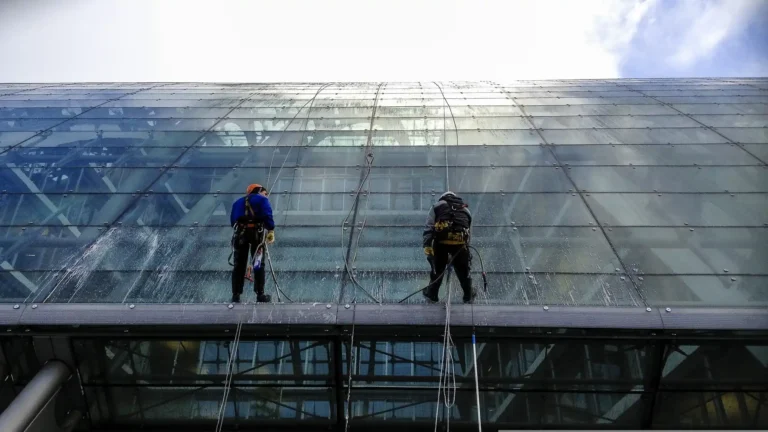
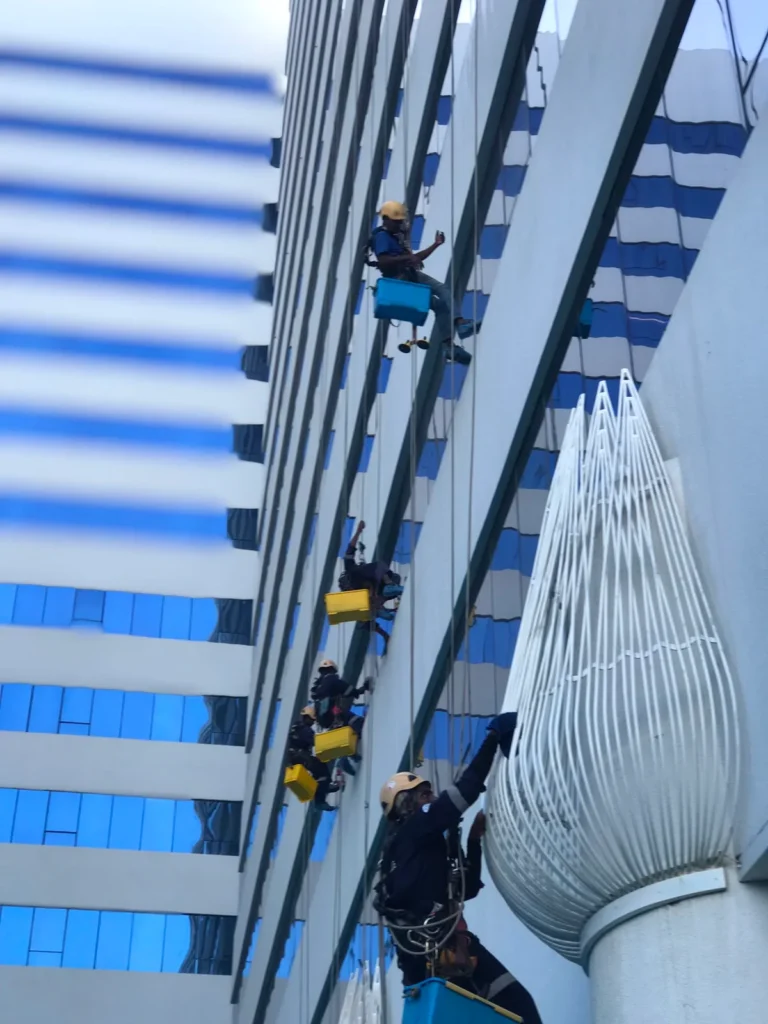
- Rope access: IRATA-certified technicians descend on ropes from roof anchors, working across the facade panel by panel. This is the most versatile method and works on any height. It’s also the most time-efficient on buildings without a permanent cradle system. Buildings in DIFC and Downtown that don’t have building maintenance units often use rope access for their glass cleaning programme.
- Building maintenance units (BMUs) and cradles: Purpose-built gondola systems installed at roof level. These are standard on most towers above 20 floors built in the last 15 years. They allow a two-person crew to traverse the entire facade systematically. The limitation is that they follow fixed tracks, so areas outside the BMU coverage, corners, setbacks, and podium sections, still need rope access or poles.
Most high-rise glass cleaning programmes in Dubai combine all three methods. The BMU handles the main facade elevations. Rope access handles the corners, reveals and any areas the cradle can’t reach. Water-fed poles handle the ground and podium levels. Whoever you choose for rope access work, ask to see the IRATA certificates of the technicians who will be on your building.
What Spring Blue’s Glass Cleaning Programme Covers
For new enquiries we start with a facade inspection. We photograph the glass on all elevations, look for existing hard water staining or coating problems, and give you a clear picture of what the building needs.
That might be a quarterly facade wash. It might be a one-off glass polishing treatment followed by a maintenance programme. We’ll tell you what’s realistic.
We work on buildings across the city: towers in DIFC, Marina and Business Bay, residential blocks in JLT and Jumeirah, and commercial buildings in Al Quoz, Deira and Bur Dubai. Spring Blue has been operating since 2017 and has served more than 1,000 facilities. You can read about our high-rise cleaning and rope access service, or call +971 52 280 7364 or message us on WhatsApp. We’ll be straight with you about what the job involves and what it costs.