
How Dubai’s Summer Heat Affects Your Building’s Exterior
Between June and September, Dubai’s exterior surfaces take a beating. Temperatures above 45°C, intense UV, Gulf humidity at night, and shamal dust storms between July and August. If you manage a building in Al Quoz, Marina, Business Bay, or anywhere else in the city, summer is not the season to ignore your facade.
Here’s what actually happens to your building’s exterior during a Dubai summer, and what you should be doing about it.
UV Damage on Glass Coatings and Sealants
Dubai’s UV index regularly hits 11 or 12 in summer. That’s extreme. Glass coatings, particularly low-E coatings on high-performance glazing, don’t fail overnight. But repeated summer cycles degrade the surface layer. You’ll notice it as a slight haze on the exterior face, or a patchy, uneven appearance when the glass is wet.
Silicone sealants around glazing panels are more vulnerable. When the surface temperature of a dark-coloured facade exceeds 70°C (common on south-facing elevations in Business Bay towers), cheaper silicone starts to crack and pull away from the frame. That’s not just a visual problem. It’s a water ingress risk for when the rains come in November.
During summer site visits we check sealant condition on every elevation. It’s one of the cheapest things to catch early and one of the most expensive to fix after water gets behind the cladding.
Shamal Dust and What It Does to Your Facade
Shamal winds typically run from late June through August. They carry fine dust particles from the desert, and they deposit that dust on every horizontal and semi-horizontal surface on your building. Ledges, sill details, louvre blades, plant room grilles, and the lower sections of any textured cladding.
The dust itself isn’t the main problem. It’s what happens when it combines with humidity. At night, coastal humidity in areas like JLT, Marina, and Dubai Harbour regularly hits 80 to 90 percent. That moisture binds the dust into a clay-like crust. Leave it through one summer and it stains. Leave it through two and it etches into porous stone or concrete.
Buildings in Al Quoz and Tecom, which sit closer to open desert areas, accumulate dust faster than Marina or DIFC towers. If your building is in that corridor, monthly facade inspections during summer aren’t excessive. They’re practical.
HVAC Condensation Staining on External Walls
HVAC systems work hardest in summer. Condensate drain lines that were marginally clear in winter back up in July. When they overflow, you get water tracking down the external wall. On painted render it leaves rust-coloured streaks. On natural stone it leaves calcium deposits. Both are difficult to remove without specialist products.
This is one of the most common facade staining complaints we deal with in August. The good news is it’s entirely preventable. A HVAC condensate line check in May, before peak cooling demand, stops it before it starts. We flag these during our pre-summer site visits.
On buildings in Deira and Bur Dubai with older HVAC installations, the drain routing often exits directly onto the facade rather than into a contained drainage channel. For these buildings, we recommend monthly checks from June onwards and keep a water-fed pole team on standby to clear new staining before it bonds.
Algae and Water Marks in Humid Areas
The Gulf humidity that arrives most nights from May onwards doesn’t just affect dust. On north-facing elevations that get less direct sun and dry out more slowly, you can see algae beginning to establish in textured surfaces, particularly rough concrete and natural stone. It starts as a light green tint on the surface. It’s invisible in photos from ground level but obvious to anyone up close.
Algae on a facade isn’t just aesthetic. It holds moisture, which accelerates surface degradation. And it makes surfaces slippery when wet, which matters for any accessible ledge or maintenance walkway.
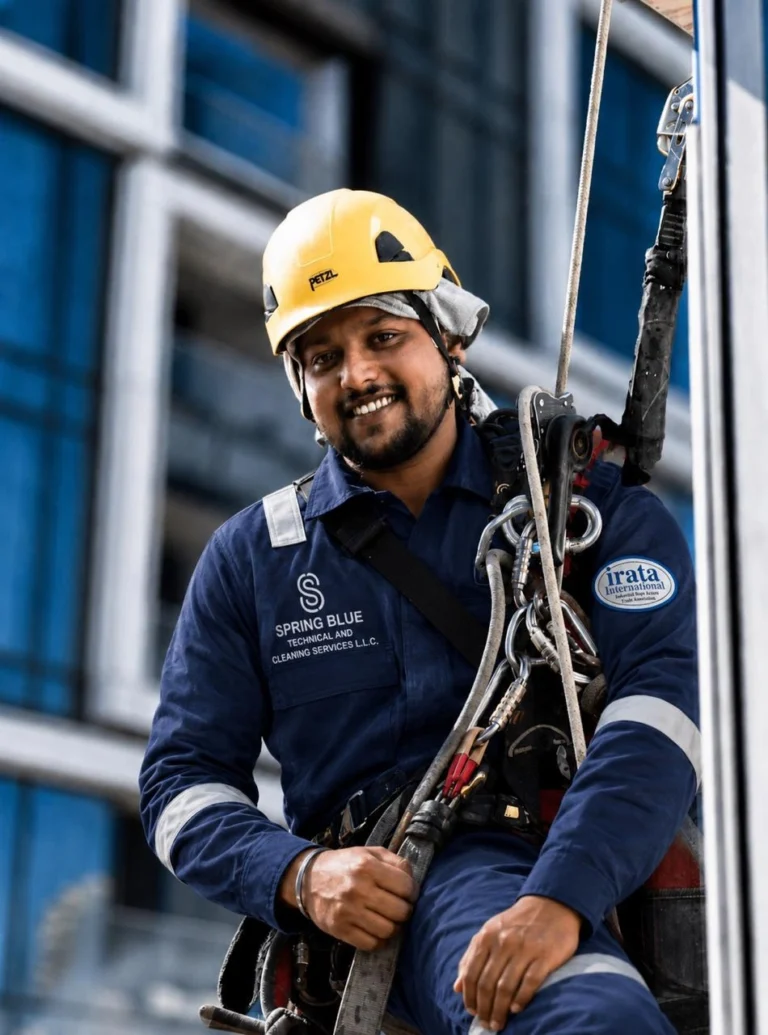
We treat established algae with biocide products on rope access cleaning Dubai, allow a dwell time of 20 to 30 minutes, then pressure rinse from above. It’s straightforward when caught early. Left for a full summer, the root structure gets deeper and mechanical scrubbing is needed, which risks surface damage.
Why Summer Is Actually a Good Time for Facade Cleaning
This surprises some building managers, but summer has real advantages for facade work. There’s no rain to interrupt jobs or wash products off before they dwell. Surfaces dry fast after washing. And rope access work, which stops when wind speeds exceed safe thresholds, has fewer wind interruptions in July and August than in November or March.
The heat is the obvious constraint. We manage it by scheduling rope access and cradle work in early morning starts, typically 5 AM to 10 AM, before surface temperatures become an issue for our technicians. Ground-level and podium work can run earlier in the morning or in the evening.
Buildings in Downtown Dubai, DIFC, and Marina that want their facades clean for the cooler months often schedule summer as their deep-clean cycle, knowing the work will hold better going into November when the social and events season begins.
What Spring Blue Checks During Summer Site Visits
Our summer facade assessments cover six areas: glass condition and coating integrity, sealant inspection on all elevations, HVAC condensate routing, dust and shamal accumulation on ledges, any new algae or staining, and anchor point and davit condition for safe maintenance access.
We provide a written report after every visit with photographs and a priority list. You get a clear picture of what needs immediate attention and what can wait until the autumn schedule.
If your building hasn’t had a facade inspection this summer, it’s worth doing before August is out. Call us on (+971) 4 343 2527 or message us on WhatsApp at (+971) 52 528 9713 to arrange a site visit. We cover properties across Dubai and can usually be on site within 48 hours.